Cleaning office support and field work: connect the responsibilities
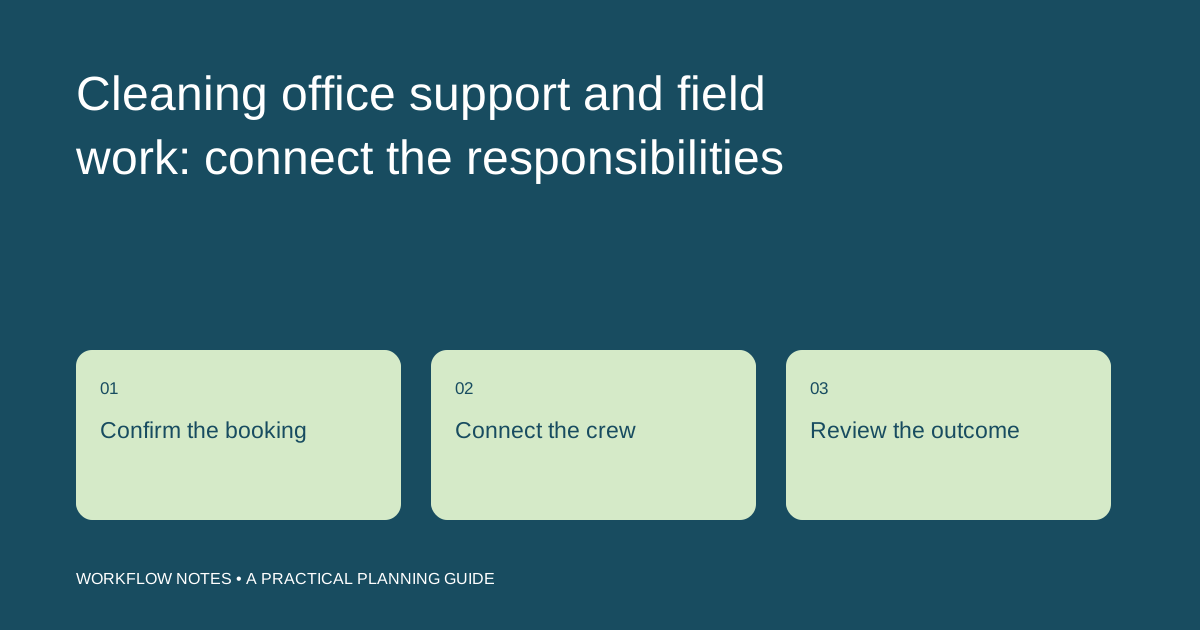
Define the handoff between booking, dispatch, service delivery, and follow-up.
A cleaning business needs both the work performed at the property and the office coordination around that work. Adding administrative support should clarify how these responsibilities connect. It should not create the impression that a remote coordinator replaces a trained crew or a field supervisor.
The source distinguishes physical service work
BLS describes janitors and building cleaners as performing on-site tasks such as floor and restroom cleaning, handling supplies, and reporting major repair needs. That description concerns the delivery of physical services. Source: BLS building cleaner profile.
Our analysis focuses on the administrative layer around a cleaning service. The source does not test remote support arrangements or establish that a particular business will gain capacity by using one.
Compare responsibilities across the handoff
| Stage | Office coordination | Field or management responsibility |
|---|---|---|
| Booking | Record approved service and time | Define service capability and scope |
| Dispatch | Send confirmed brief and updates | Assign suitable crew and equipment |
| Job exception | Capture the issue and contact owner | Decide safe and appropriate action |
| Follow-up | Route feedback and track response | Assess quality and approve remedies |
This division is a proposed planning model. A business may allocate responsibilities differently, but every stage still needs a named owner and an agreed decision route.
Scope the role around a recurring queue
Start with a concrete problem: unconfirmed access details, appointment changes not reaching crews, or customer follow-ups without an owner. These are more useful starting points than “help with the office.” They identify the record, the communication, and the person who depends on the output.
Choose one service type for the initial scope. A recurring residential visit and a one-time commercial project may have different booking questions and approval rules. Combining them too early can produce a long script that still fails to handle the important differences.
Include the limits of remote coordination
The assistant cannot observe conditions at the property directly. If a crew reports a concern, the workflow should record the message and route it to the authorized supervisor. Do not ask the assistant to infer whether a specialist task is safe or feasible from an incomplete customer description.
Similarly, an updated schedule does not prove that the crew saw a change. Decide when acknowledgment is required and what to do if it is missing. This is a communication design choice the business should make explicitly.
Evaluate service promises separately from activity
A coordinator may send many messages without resolving the uncertainty that caused them. Review whether appointment records contain the approved scope, whether access is confirmed, and whether changes reach the right people. These checks measure the quality of the handoff more directly than message count.
Customer satisfaction, repeat business, and profitability depend on more than administration. If you track those outcomes during a pilot, describe the other changes and avoid attributing every improvement to the support role.
Prepare a practical brief
Bring the service descriptions, booking rules, scheduling tool, and exception policy to the scoping conversation. Identify who can approve extra work, changes in price, and customer remedies. The assistant’s communications should reflect those decisions rather than create new commitments.
Our cleaning office administration and customer care follow-up services can support these queues. The dispatch-ready schedule guide explains one end-to-end handoff in more detail.
Source reviewed November 10, 2026. The comparison is editorial guidance; examples do not represent measured client outcomes.